Zephyrtronics Equipment is Engineered & MADE IN THE U.S.A.
SMD Removal LowMelt® DeSolder Removes Chip Quickly Through Hole & SMT Removal The Original!
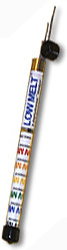
LOWMELT® DESOLDER WIREExtra Low Temp SMD & Thru-Hole Removal & BGA Pad Re-Dressing Solder for Your PCB's!
World Famous Brand! Also Available in a Lead-Free, RoHS Compliant Formulation! In-Stock!
SMD
&
ThruHole Removal Below 150°C (302°F)
Remove
SMD's At Temps Below 150°C: Yes,our
world-famous
LowMelt®removes SMD's
and Thru-Hole chips at temperatures
hundreds of degrees below other de-soldering
methods. Below 150°C! And
LowMelt®
is available
in both RoHS compliant (lead-free)
and in classic leaded alloys.
No
Nozzles! And LowMelt®DeSolder Wire removes most chips without
scorching, clumsy and pricey nozzles
for every SMD chip! That's right...absolutely
no nozzles! LowMelt®
de-solders through Co-Metalization
process
with only a pre-heater below the PCB!
If you don't have a preheater, use your desoldering tool
or a simple soldering iron. Rework benches should have LowMelt®
at the technician's fingertips when needed. It is an
essential for any electronic assembly or rework bench.
And a little goes a really long way!
Just a dab at the pin/lead interface removes large SMD's.
The Original & World-Famous LowMelt®
DeSolder Wire
for Easy Removal
of SMD Chips! Zephyrtronics Original!
Simpler?
Safer? You bet!
So many benefits
with LowMelt® Lower
heat. Lessens PCB damage.
1. Prevents burning, warping PCB's
in rework. 2. Prevents lifting pads during rework.
3. No need for nozzles to remove SMD's. 4. Remove thru-hole chips &
connectors easier 5.
Prevents high temp damage to I.C's & caps 6. Eliminates sticky de-solder wick with BGA's.
7. De-clogs
your de-soldering tools quickly.
8. ReDress
weak BGA pads without wick/braid.
LowMelt®
& AirBath™
Synergy!
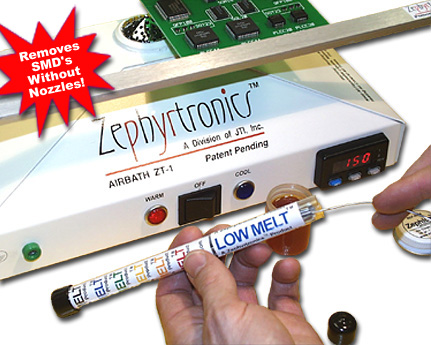
Zephyrtronics invented the synergistic combination of
LowMelt®
DeSolder
together with our famous, trademark
AirBath
Preheat:
a truly
comprehensive, easy-to-perform benchtop
answer to SMD and thru-hole chip
removal:
LowMelt®
Co-Metalization Process.
Lead-Free & Classic Lead Formulations:
LowMelt®
is available in
either our classic, leaded
LMSSeries
or in our lead-free,
ZLM
Series packed in convenient
storage tubes. (Ships with certs and MSDS)
De-Clogging DeSoldering Tools:
Ever struggled cleaning clogged desoldering
tools? Problem solved. A
little
LowMelt®
quickly unclogs away old hardened solder
inside! Another Zephyrtronics first!
Re-Dressing BGA Pads
Before Re-Balling:
LowMelt®is ideal for re-dressing
BGA pads after chip removal! Better than
using
problematic braided wick and soldering irons that
damage BGA's. Delicate BGA pads are weaker than pads
on a PCB.
Using LowMelt®
with a preheated BGA is superior
for removing old solder from BGA's before
reballing BGA's.
Note, LowMelt®
is
not for making
new solder joints, only for desoldering.
Will
LowMelt® De-Solder
Thru-Hole Connectors & Chips?
Absolutely!
LowMelt®
& AirBaths™ Tested & Certified!
After
extensive testing and evaluating Zephyrtronics'
AirBath™
and
LowMelt®
DeSolder aerospace and
defense contractors approved and
recommended them. One
concluded in a 108-page report:
"Finally, given the advantages
of lower rework temperatures, and the results of this
evaluation, the use of this
method and material for
reworking SMT and difficult
through-hole boards is
recommended...this
"new process significantly
reduces the necessary...actual
rework hot gas and/or solder
iron temperatures and rework
time. Additionally, the chances
of board damage, pad and land
damage, and component lead
damage are significantly
reduced...results essentially
indicated there were no
negative impacts on solder
joints or long-term reliability
given the use of this new
material and methodology."
See the
LowMelt®
Video Demo Below
History
of the
LowMelt®
DeSolder Wire: The Real Story
Brief
Historical Perspective of LowMelt®
DeSolder: You may be surprised to
learn that a more primitive use of low
temperature solder alloys for component removal had
actually been around a very long time.
This brilliant concept was originally
pioneered by the late Joseph Funari in
the 1960's.
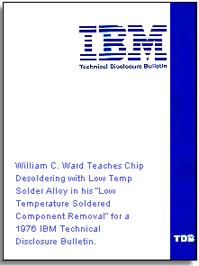
A decade later in the
1970's, William C. Ward of IBM,
explained and published Funari's
concepts in IBM's Technical Disclosure
Bulletins.
Moreover,
there was a very clever Russian
patent also issued many decades ago combining both a
low melting point solder with a soldering iron to
remove electronic chips. How about that?
And at that same
Expo,
Zephyrtronics was awarded
"Best New Product" of the year
winning the prestigious Vision Award
there,
as the company demonstrated its new
jaw-dropping, innovative co-metalization
"touch-free" process dazzling the
crowds. How quickly the word
spread.
How to
Use
LowMelt®
DeSolder Wire
William C. Ward Article in IBM's
Technical Disclosure Bulletin: Low
Temp Alloys for Chip Removal
Yes, LowMelt®
Works With Soldering Irons, But Better
With Non-Contact Preheat:
Customers ask us: why not
recommend using ordinary soldering
irons to mix the LowMelt®
directly into the chip's existing solder
joints to remove chips? Of course, this
technique -- as mentioned above -- has
been around since the 1960's, so
LowMelt®
works this way. But...
Dr. Charles Hutchins, a
founder of Surface Mount Technology
Association (SMTA), wrote most PCB damage during rework and repair
results from either high temperatures, excessive
hand pressure or a combination of both.
Of course, a soldering iron introduces
high temps, hand pressure and contact
into the equation.
So, Yes, It "Works", but we say
there's just a far better, lower
temperature and 100% non-contact
method. Since the 1990's,
Zephyrtronics, pioneer in this
technology synergy, has recommended using a
non-contact
AirBath
Pre-heater beneath the PCB in
conjunction with
LowMelt®DeSolder Wire as shown the video
above. This superior method is what NASA
called "touch-free," and maximizes the
benefit of low temperature rework.
Certainly, the proven synergy of
LowMelt®
De-Soldering Wire and the
AirBath™ preheating systems make it
a natural for any electronic
benchtop where prototyping and/or
rework of PCB's is performed.