|
|
|
|
|
Hot Air Soldering Hot Air Pencil SMD Rework PCB Repair Non-Contact Touch-Free Micro Soldering for Ceramic Caps
|
|
|
|
|
|
|
|
|
|
| History & Theory of
Operation: |
|
|
|
|
|
|
|
|
|
|
 ™
A Hot Air Pencil Should Be "Pencil" Thin To Provide Chip Visibility ™
A Hot Air Pencil Should Be "Pencil" Thin To Provide Chip Visibility
|
|
| |
|
|
|
|
|
|
|
|
|
| |
|
|
|
|
Copyright © 1996, 2008, 2009, 2010, 2011 and 2012 by David Jacks
|
|
|
|
| |
|
|
|
|
|
|

Zephyrtronics Equipment is Designed, Engineered,
and Manufactured in the United States of America.
ZeroTouch™
Soldering
 |
|
|
OVERVIEW: |
|
|
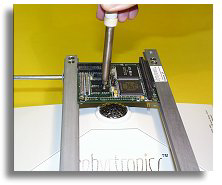
A Hot
AirPencil is Shown Above Used
In Concert With a
Bottom-Side Preheating AirBath.
Micro Soldering for
Microscope Soldering |
|
The
introduction of the hot air pencil as a soldering device
for surface mount devices for high quality soldering
reflow on PCB's
at a bench
--- whether in prototype, design or rework/repair
--- along with bottom-side PCB preheating seems
obvious now, but it it was not always so.
The hot air pencil made its entry into the PCB
production world in the 1990's almost 10 years
after the advent of surface
mounted technology.
Together, the AirPencil™
with preheating proved that it was then possible to
mimic the initial production soldering thermal profiles,
processes and equipment.
|
|
|
|
Even the briefest study of
any state-of-the-art, high volume PCB production process
--- along with the most basic semiconductor data books
--- will emphasize how precise handling
methodologies and exacting solder reflow prerequisites
are essential for many very critical quality reasons.
And since it only logically follows that all PCB tasks
performed at a benchtop should be held to the same equal standard
of high-volume production, some fundamental conclusions can be made
as just how to achieve premium solder joints at the bench: |
|
|
|
|
|
|
|
|
|
|
|
|
-
All PCB's should be
carefully thermally
ramped 2ºC-4ºC per second
with a preheating “soak” prior
to soldering or desoldering tasks whether in
production, prototyping or in rework or repair.
-
Non-contact and
non-contaminating hot air soldering (convection)
is best suited for ceramic chip resistors and
capacitors.
-
Non-contact and
non-contaminating hot air soldering (convection)
is best suited for placement of fine pitch and
ultra-fine pitch semi-conductors.
-
When hot air is used
to remove or replace SMD's, the air-stream must
be pin-pointed precisely to the targeted leads
and pads with a
hot air pencil
or with extra-low velocity
hot air nozzles
if with a larger SMD/BGA Hot
Air Benchtop system.
|
|
|
|
| |
-
Components adjacent
to an SMD that is being removed or replaced
should never be exposed to elevated reflow
temperatures.
-
PC boards and their
components should never be subjected to
temperatures greater than originally seen during
initial production reflow.
-
An accelerated cool
down of the solder joint is desirable and
recommended to insure robust joints and to
prevent accidental skewing, misalignment, and/or
tomb-stoning.
-
Static-sensitive
electronic components should be protected during
printed circuit board assembly rework from
accidental static discharges. And the use of an
ESD wrist strap by the rework engineer or
technician is recommended.
|
|
|
|
|
|
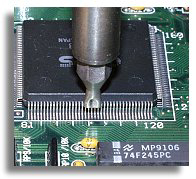
The Hot AirPencil
is Shown Above Soldering a Quad Flat Pack (QFP). Notice the 100%
Non-Contact of the AirPencilto Delicate Leads. |
|
A BRIEF HISTORY: CONVECTIVE vs CONDUCTIVE REFLOW:
PCB soldering generally is divided into
two methods: convection and conduction. With the advent of
SMD's and chip miniaturization, any physical contact, conductive soldering
quickly lost favor with manufacturing and quality engineers. High volume conveyor ovens and hot air equipment (convective)
quickly became preferred over the traditional contact methods (conductive) such as
soldering
irons, hot bars, thermodes and even wave soldering. |
|
|
Creating
electrically sound and physically robust solder joints --
between a chip's leads and its tinned copper pads -- requires
attention to many process parameters. Within even the most
nominal PCB assembly, a host of dissimilar materials can be
found: copper, fiberboard, ceramic, plastic, tin, lead,
silicone, laminates, and more. Each of these distinct materials
have varying thermal expansion rates. If ignored during exposure
to solder reflow temperatures, many compounding problems. |
|
|
|
|
|
|
|
Ceramic Chip Resistors & Caps
& the Hot Air Pencil. As the transition from Thru-Hole to SMT accelerated, an immediate drawback with the use of soldering irons and hot tweezers
appeared: miniature ceramic chip capacitors and resistors
cracked or fissured when soldered to the PCB. The cracking problem
rose up from the severely unequal expansion rate
between the ceramic chip and its leads created by contact soldering
irons. Thus, pin-pointed hot air soldering became the
favored method. But how best to do it?
In 1994, Randy Walston
and I introduced the first true
hot air pencil
to the soldering market to great fanfare at the
NEPCON West Electronic Exposition in Anaheim,
California. In fairness, there had been other
hand-held hot air soldering tools on the market, but
they were either large in diameter, bulky, awkward
to hold, blocked the vision of a technician from the
chips to be soldered, powered by high voltages where
transient leaks and switching voltage spikes put
noise into the power lines (and damage SMD's if
touched), or were re-packaged hot air "tools" inside
of existing soldering iron handles. The
patented AirPencil™ design stole the show attended
by nearly 40,000 engineers, technicians, designers,
manufacturers and quality personnel. Over 2,000
written inquiries to the show's administrators were
submitted. |
|
|
|
Today, most every
manufacturer of ceramic capacitors and glass diodes have
published papers and warnings that they are not responsible for
damage done to their ceramic caps induced by hand soldering
irons because of the above stated problems and state that
soldering irons are prohibited as soldering tools with their
devices.
Yes, one could remove a
chip quickly with a heated contact tool (soldering
iron or hot tweezers), but once removed, the chip
could not be re-used.
Cracking & Fissuring:
More importantly, soldering new ceramic chip
capacitors and resistors with contact type tools
became prohibited by many prestigious electronic
firms to prevent chip cracking/fissuring.
Instead of the soldering iron and hot tweezers, the
hot air pencil quickly became the preferred tool for
soldering ceramic chip SMD's. Moreover, the hot air
pencil proved most effective in the removal of chip
capacitors, chip resistors, and SOIC's when utilized
with
(non-heated) tweezers.
Also, hot air pencils,
not soldering irons, became preferential preparing
or "touching up" pads. Soldering irons can leave
tags or ice cycles on the pad causing co-planarity
problems at the lead/pad interface. A hot air pencil
leaves a smooth pad. This process is now known as
hot air leveling. |
|
|
|
More Advantages of
Non-Contact Soldering:
The beneficial
applications of the hot air pencil quickly transcended more
than just ceramic chip caps, resistors, and SOIC's. The hot air
pencil quickly proved to be superior for soldering of a newer type
of SMD: fine and ultra-fine pitch devices (FPT & UFPT).
Between 1988 and 1995,
demand by designers for higher I/0 counts on IC's
pushed electronic packages to extremes. Earlier
SMD's had lead counts at 100 or less with pitch
spacings typically between 0.040" and 0.050", but
newer FPT and UFPT chips had I/O counts as high as
250 plus. Complicating things further, these devices
had pitches as small as 0.015".
In 2004, NASA
heralded the "touch-free, precision soldering
method" of the patented Zephyrtronics AirPencil™
in
a 104-page report recognizing the aforementioned
attributes of pin-pointed hot air for PCB tasks.
"Touch-free." Perfectly said.
|
|
|
|
|
|
|
|
|
|
|
|
|
|
Limitations of Hot Contact Tools and
QFP's. Where hot
contact soldering irons, hot bars, and hot tweezers were
inadequate for the placement of ceramic chip capacitors
and resistors, the limit of their usefulness became more
apparent with the arrival of these ultra fine pitch
components like Quad Flat Packs (QFP's). Chip
miniaturization also translated into tinier leads, too. |
|
|
|
In fact, the component's leads
spotlighted the disadvantage of soldering irons when compared to the non-contact (hot air) method. The leads became so
delicate, so small in overall footprint (width, thickness, and even extension of the toe) that they proportionately became extremely susceptible to bending, twisting out of their axis and deforming whenever touched by a contact type tool. |
|
|
|
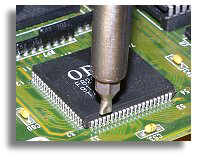
The Hot AirPencil
is Shown Above Soldering a PLCC Package. Notice the 100%
Non-Contact of the AirPencil to the Delicate Leads. |
|
|
|
| |
|
|
|
|
|
|
|
|
|
|
|
Advantages of Hot Air Pencil Over Hot Contact Tools.
An AirPencil™ hot air never "touches" the component or its
tiny, fragile, and weak leads. The opposite is true of the hot
contact reflow tools where the tool can "stick" to SMD leads,
bend SMD leads upwards/downwards causing co-planarity problems, tweak SMD outwards/ inwards causing electrical shorts or
opens. The AirPencil™ pencil presents none of these
problems. It allows no opportunity for introducing contamination
to the PCB as opposed to the hot contact tools. Dirt, grime, residual flux and adhesives can and often
stick to contact tools cross-contaminating PCB...and creating even more quality problems. |
|
|
|
|
Plus, the
AirPencil™ can be used to gently pre-heat the surrounding area of
a targeted chip before soldering or desoldering so lower temperature settings and shorter reflow dwell times
can be achieved.
Of course, the preferred and most quality-effective, auxiliary compliment to the
hot AirPencil™ is a temperature-controlled,
bottom-side, forced-convection preheating system.
Such a mild pre-heating of the PCB right at the bench can really be of great assistance when processing PCBA's with heavy ground planes, multi-layers, or large heat sinks.
-- David Jacks, 1996
Los Angeles, California |
|
|
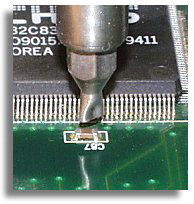
Ceramic Capacitors
Must Be Reflowed With a Hot AirPencil Instead of a Contact-Style
Soldering Iron Which Fracture and Crack the Chips. |
|
|
|
|
|
|
|
|
|
|
|
|
|
|
|
|
| |
********************* |
|
|
|
ABOUT THE AUTHOR:
David Jacks was Director of Engineering with
the two largest soldering equipment manufacturers in
the world, Weller®
and Ungar®
collectively for over 14 years before founding the
Zephyrtronics®
company in 1994 with his fellow design engineer Randy Walston.
In the 1980's, David played a significant role in
helping the printed circuit industry transition to
surface mount from through hole technology. |
|
|
|
David's
professional product design career as an inventor stretches from the early
1970's in Los Angeles. His original groundbreaking designs and products have been
spotlighted in feature articles in both Popular Science®
and Popular Mechanics®
Magazines, a rare accomplishment.
For decades, David designed award-winning products,
appliances and tools for many global iconic brands.
|
|
|
|
David's original products have been marketed by Sears®,
Black & Decker®,
RadioShack®,
Motorola®,
Snap-On Tools®,
Rubbermaid®,
CooperTools®,
Farmer Brothers®
and Brewmatic®,
Weller®,
Ungar®
among others. David holds multiple patents (utility and design) for his many
inventions; has authored technical articles for national journals and routinely speaks to electronic professional societies. |
|
|
|
|
|
|
|
|
|
|
|
|
|
|
|
|
|
|
|
|
|
|
|
|
| |
|
|
 |
|
|
|
|
|
|
|
|
| |
|
©1996 - 2011, 2012,
2013, 2014, 2015, 2016, 2017-2018, 2019,
2020 - 2024 by Zephyrtronics®. All rights reserved.
The information, text, images, photographs, charts, graphs you
receive online from Zephyrtronics® are protected by the
copyright laws of the United States. The copyright laws prohibit
any copying, redistributing, retransmitting, or repurposing of
any copyright-protected material. Zephyrtronics is the
registered trademark property of JTI, Inc. "The Science of
Zephyrtronics" and "Simplicity Through Innovation" and "Zephlux"
and "ZeroLead" and "Zero Balling" and
"ZeroTouch" and "Zero Residue" and "Post
Cooling" and "Post Cooler" and "AirBath" and "SolderGlide" and
"ZeroTouch" and "SolderMill" and "Just So Superior" are the protected trademark
property of JTI, Inc. "Zephyrtronics" and "Low Melt" and "Air
Fountain" and "Fountainhead" are the registered trademark
properties of JTI Inc. *The above names are the registered
property of their respective owners. |
|
|
|
|
|
|
|
| |
|
| |
|
SMD
Rework,
SMT Rework
AirBath Air Bath,
SMD Rework Stations,
Hot Air Pencil Soldering,
BGA Rework Stations,
CSP Rework Stations,
Preheating Systems,
PCB Preheaters,
Pre-Heat SMT/ SMD,
Low Temp Rework,
SMT DeSoldering Tools,
Vacuum Pickup Tools,
Circuit Board Holders,
PCB Fixture & PCB Holders
&,
Board Cradles,
Rework Solder Paste,
No-Clean Solder Paste,
Low Melt®
De-Solder Wire,
DeSolder Wire,
Hot Air Rework Stations,
Fume Extractors,
SMT Dental Probes,
SMT, SMD Rework Kit,
BGA Rework Kit,
LMK Kit,
BGA Re-Balling Kit,
SMD Tweezers,
Power Palm Plunger,
QFP Lead Straightener
How
To - SMT, CSP, BGA Rework
How To - BGA Alignment;
How To - SMT Rework;
How To - PCB Preheating,
How To - BGA & CSP Rework;
How To - Quickly Solder
SMD Packages Effectively;
How To - CSP Alignment;
How To - Lead-Free Rework;
How To - SMD Removal
Economical;
How To - SMD Removal
Professional;
How To - Hot Air Pencil /
AirPencil Soldering;
How To - SMD Quick Chip
Removal;
How To - BGA Re-Balling;
How To - Rework PLCC, QFP,
QFN, LCC, SOIC, SOL, Shielded SMD, TSOP;
How To - Solder & Rework
Ceramic Capacitors;
How To - Solder & Rework
Glass Diodes;
How to Repair Smartphones,
Tablets and Laptops
Soldering,
De-Soldering
Soldering Accessories,
Solder Wire,
No-Clean Solder Wire,
Eutectic Solder Wire,
Solder Wire Dispenser,
Solder Paste,
Lead-Free Solder Paste,
Flux,
Solder Paste Dispensers,
Low Melt®
DeSolder Wire,
De-Solder Wire,
Soldering Tips,
Thru-Hole DeSoldering
Tools,
DeSoldering Tips,
Tips for DeSoldering,
De-Solder Wick &
DeSoldering Braid,
Smoke Extractors,
Fume Extractor Filters,
Carbon Activated Filters,
SolderMill™,
Solder Sucker / DeSolder
Pump,
Pre-heating Systems,
Preheat Thru-Hole,
PCB Pre-heaters,
Flux Solvent,
How To - Connector Rework;
How To - PC/104 Soldering
and Rework;
How To - Thru-Hole /
Through Hole Desolder / De-Solder;
How To - Low Melt®
Desolder Wire;
How To- Stop Lifting Pads;
How To- Desolder /
De-Solder Heavy Ground Planes;
How To - Lead-Free
Soldering and De-Soldering;
Pre-Heaters for Lead-Free Rework and Soldering
Dispensing Equipment, Gear, Supplies, Dispensing
Bottles & Dispensing Accessories
Dispensing Systems,
Dispensing Syringes,
Dispensing Barrels,
Tapered Dispensing Tips,
Blunt Needles,
Dispensing Bottles,
Stainless Steel Needles,
Dispensing Needles,
Industrial Needles,
Dispensing Tips,
Industrial Dispensing
Tapered Tips and Needles,
Dispensing Accessories,
Flux Bottles,
Solder Paste in Syringe,
Paste Rack Solder Paste
Holder™,
Dispensing Supplies,
Power Palm Plunger,
Manual Dispensing,
Alcohol Pump Bottles,
Automatic Dispensing,
Squeeze Bottles, Wash
Bottles, Brush Bottles, Spout Bottles, Pump
Bottles
Benchtop Accessories,
Bench Supplies,
Benchtop Tools
SMD Solder Paste,
Solder Wire,
LowMelt®,
No-Clean Flux,
BGA Flux,
Rework Tack Flux,
Non-Flammable Flux Remover,
Pen Vac,
SMT Tweezers,
Fume Extraction,
SMD Tweezers,
PC Board Fixtures,
Hot Air Tips,
AirTips,
Replacement Soldering
Sponges,
Iron Plated Soldering Tips,
Foam Swabs,
Anti-Static Foam Swabs,
Thru-Hole & Solvent
Brushes,
Helping Hands,
LMK Rework Kits,
X-BOX 360 Repair,
Wire Strippers & Wire
Cutters,
Flush Cutters, Micro
Shears & Needle Nose Piers,
Straightening Tool for
QFP Leads,
ESD Wrist Straps,
ESD Wrist Strap Tester
Updated
for September 21 , 2024 |
|
|
|