|

Zephyrtronics Equipment
is Designed, Engineered,
and Manufactured in the United States of America.


|
|
|
How To Solder Your Surface Mount Devices (SMD) With Solder Paste and a Hot Air Pencil. Quality SMT Soldering!
|
|
|
|
|
|
|
|
|
|
|
How to Use Solder Paste & Hot Air Pencil Soldering. First Introduced to the World in 1994 by Zephyrtronics!
|
|
|
 MAKING HIGH-QUALITY SMT SOLDER JOINTS
Copyright © 1996 - 2010, 2011, 2012, 2017, 2018 by David Jacks.  All Rights Reserved.
|
|
|
|
|
|
|
|
|
|
|
INTRO:THE ADVANTAGE OF THRU-HOLE OVER SMT
|
|
|
|
|
|
|
|
|
|
|
|
Beyond the obvious benefits
of surface mount technology (SMT)
over traditional through-hole technology (THT or Thru-Hole), there
is one immediately recognizable advantage
with thru-hole: the strength of the solder joint.
In thru-hole assemblies, the leads of a component
first penetrate through the substrate
(some are even clinched on the other side) and afterwards, the lead is soldered.
And with plated thru-hole PCB's, the solder wets down
inside of the plated hole adding strength to the
pad/lead interface. |
|
|
|
High Reliability
Soldering. It is easy to appreciate why
such solder joints provide high expectations for
reliability (Figure 1).
However, with SMT, only the tiny solder
joint alone a top of the substrate's surface must
provide all of the mechanical connection in
addition to the electrical connection. Therefore,
the quality of a solder joint on SMT
assemblies is far more critical than traditional
thru-hole solder joints requiring greater attention process
parameters when surface mount soldering |
|
|
|
| |
|
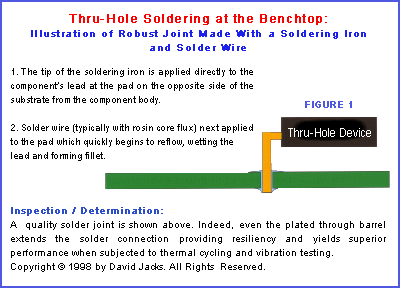 Detailed View of a Through-Hole Soldering Joint
|
|
|
|
|
|
|
|
|
|
|
|
|
|
|
DOUBLE STANDARD -- QUALITY JOINTS IN PRODUCTION, BUT BAD JOINTS EXCUSED AT THE BENCH
|
|
|
|
|
|
|
|
|
|
|
|
For integrity and strength
at each solder joint, it is imperative that an SMD's
leads always have fillets at the toes, heels and sides. This is true whether the soldering is made
during initial production or later in rework,
but. unfortunately, while such fillet criteria has
been standard in production processes, it is still universally
mostly ignored at the bench where
PCB prototyping and rework is performed.
Most inferior SMT solder joints
made at the bench result from two hangover processes
used with THT: a.) using solder wire rather than solder paste; and b.) using contact soldering irons rather than non-contact hot air. |
|
|
|
Where's the
solder wire? There
is not a single high-volume SMT soldering
that utilizes solder
wire. Ponder that. Either the popular use of solder paste
in reflow ovens or molten solder with wave
soldering are the proven, established
norms.
So what about solder wire? Historically, solder wire (typically cored with flux) was a staple with THT for decades
at the bench. For over half a century! Where
wave soldering was not feasible or
affordable, the long assembly line of
personnel outfitted with soldering iron
stations
was the status quo for all those years in electronic
production. |
|
|
An old,
disappearing paradigm. And sitting
alongside each soldering iron there was always the ubiquitous spool of solder wire. And so it followed that the individual rework bench was a mere snapshot of the assembly line: soldering iron, spool of solder wire, wick, bottle of flux, etc.
This world
changed beginning in the late 1970's and early
1980's with the introduction of surface
mounted chips when components became smaller
and could be soldered on both sides of a PC
board and the old traditional methods of
soldering at the benchtop were becoming
obsolete. |
|
|
|
|
|
|
|
|
|
|
|
|
|
|
|
|
|
Detailed
View of a Bad SMD Soldered Joint
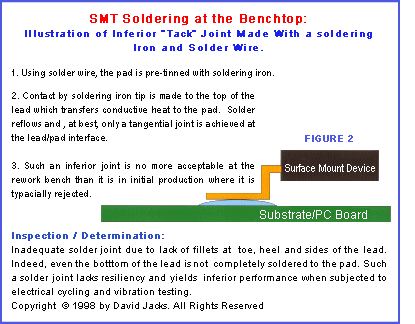 |
|
|
The advent of SMT
created a proportional decline in the traditional THT assembly and with it
traditional contact soldering iron and solder wire. The trend is irreversible. Try reflowing a BGA with an iron and solder wire.
Curiously, as solder wire and the traditional conductive soldering iron were together transcending into history at the production level, they were still
struggling for survival at the rework bench, and with lots of problems. (Figure 2) |
|
|
|
Soldering iron
woes: Some of the more notable problems related contact
soldering irons and solder wire with SMT were: lack of solder fillets at the toe, heel and sides
on both J-leaded and gull wing devices; inducing pad damage and co-planarity problems due to hand pressure from the iron while contacting the
chips; and cracking ceramic devices due to sudden application of direct conductive heat
from soldering irons to these delicate devices.
Necessity became the mother of invention: the
hot
air pencil. |
|
|
|
|
|
|
|
|
|
|
|
|
|
|
|
|
|
|
|
|
First,
soldering paste has proven to be a near perfect compliment to high volume SMT production reflow.
The process is as follows: A.) Paste is dispensed or screened to the
printed circuit substrate; B.) components are seated into the paste at
the pick and place sequence; C.) preheating at first tunnel of oven activates
flux within the paste (and warms the board); D.) solder
reflow in last tunnel as solder paste wicks up SMD leads
yielding premium solder joints replete with fillets;
and E.) quick cool down of the PCB assembly for strong
solder joints. |
|
|
|
Paste is Trumping Wire. While it is somewhat new to the rework bench (there were some early converts years ago), solder paste is now rapidly gaining favor over the use of
solder wire
when prototyping new designs or reworking SMT
assemblies.
Thermal Profiles & Solder Paste:
With a
convective preheating device,
(Airbath™) under the board assembly, solder paste can be
reflowed with a hot air pencil from above
yielding solder joints that rival those from the
conveyor oven. |
|
|
|
More Forgiving. Solder paste
melts and reflows at the lead yielding fillets at the toe, heel, and sides of the device right at the bench. (Figure 3) In fact, the use of paste can even forgive some co-planarity problems as the solder wicks up the lead from the pad.
Preheating during benchtop rework is as integral to the reflow process as it is in initial production.
Also, activation of the flux during pre-heating cleans and enhances the wetting process resulting in smooth and shiny joints that will feather out to the a thin edge. |
|
|
|
|
|
|
|
|
|
|
|
|
|
|
|
|
|
|
|
|
|
|
|
|
|
|
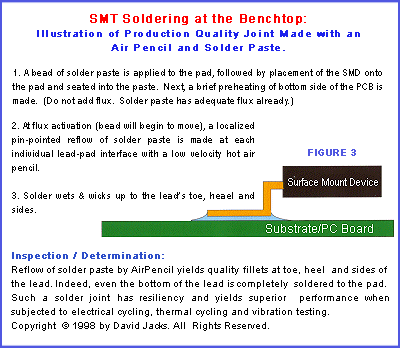 Detailed View of a Quality SMD Soldered Joint
|
| |
|
"These basic processes have the advantage that they are simple, require minimal training and virtually never cause damage to the assembly," Jerry Green, a senior manufacturing and quality engineer in San Diego points out, "you can actually see the solder reflow and become shiny" as the
AirPencil passes over the leads. Green emphasizes it is critical that the SMD sit flat on the pads, that the paste be non-rigid, that the SMD not be moved once preheating has begun, and proper inspection be made after reflow. |
|
|
|
Solder paste, not wire? Yes, as in high-volume production processes, instead of solder
wire? Right at the bench? You bet.
Forced convection from a hot air pencil like in high-volume production
processes, instead of contact, soldering irons? Right at the bench? You bet.
Ramping at 2°C to 4°C as in production? Preheating the PCB allowing flux
activation before final reflow as in production? All at the bench? You bet. |
|
|
| |
|
|
|
|
|
|
|
|
|
|
| |
|
|
Some Final Thoughts:
Use of solder paste coupled with a hot air pencil and a warm air bath at the bench is rapidly gaining favor due to the many evident advantages over solder wire and contact soldering irons.
A few last points:
1.) It is not advisable to use solder paste with a soldering iron as it
gets very messy;
2.) Hot air pencils are
less effective without pre-heating. Green stresses that "preheating cannot be rushed";
3.) Air pencils
require low velocity hot air so not
to blow solder paste/balls across your PCB; |
|
|
|
4.) A hot
air pencil is not to be confused with the larger hand-held hot air jets with larger nozzles that enclose the entire component. The air pencil provides only
pin-pointed hot air to one lead at a time.
Finally, for a quick, step-by-step, color pictorial presentation of how to solder
SMD's with solder paste and a hot air pencil, please visit our helpful primer at this direct link:
"SMD Soldering Made Easy at the Bench".
Or watch a live
video demonstration of how to use solder paste
with surface mount chips. |
|
| |
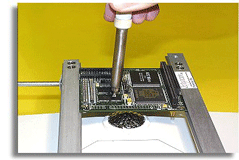
High Quality Soldering With Preheat,
Solder Paste & A Hot Air Pencil |
|
|
|
|
|
|
|
|
|
|
|
|
|
|
|
|
|
|
|
|
| |
|
David Jacks was
Director of Engineering at three Fortune 500
corporations along with the two largest
soldering equipment manufacturers on earth for
13 years before launching Zephyrtronics
in 1994 with fellow
engineer, Randy Walston.
David's professional design career
stretches from the early 1970's. His original products have been
spotlighted in feature articles in both Popular Science®
and Popular Mechanics®
magazines and have ranged from
commercial coffee brewers and radio frequency controlled residential
garage door openers to hobby glue guns, professional heat gun paint
strippers and sophisticated industrial soldering equipment.
|
|
|
|
He has designed
products, tools and appliances marketed by Sears®,
Black & Decker®,
RadioShack®,
Motorola®,
Stanley Tools, Snap-On Tools®,
Rubbermaid®,
CooperTools®,
Weller®,
Hakko®,
Ungar®,
Farmer Brothers®
and Brewmatic®.
Any electronics catalog
of soldering equipment, tools and products today
reflects David's long and enduring influence on the
printed circuit board industry world-wide.
David holds many patents
(both utility and design) in North America, the
European Union, Japan and around the world.
|
|
|
|
His
patented inventions have been cited as prior art by
firms from IBM to Mitsubishi. He has authored technical articles for international journals,
and routinely speaks to electronic professional societies.
Now in his old age, David's
keen interests is in encouraging inventors and
designers to "stick with it" and never to surrender
their dreams, and to "make the impossible possible"
through science and technology.
|
|
|
|
|
|
|
|
|
|
|
|
|
|
|
|
|
|
|
|
|
| |
|
|
 |
|
|
|
|
|
|
|
|
|
|
| |
|
©1996 - 2011, 2012,
2013, 2014, 2015, 2016, 2017, 2018, 2019, 2020, 2021 - 2024
by Zephyrtronics®. All rights reserved.
The information, text, images, photographs, charts, graphs you
receive online from Zephyrtronics® are protected by the
copyright laws of the United States. The copyright laws prohibit
any copying, redistributing, retransmitting, or repurposing of
any copyright-protected material. Zephyrtronics is the
registered trademark property of JTI, Inc. "The Science of
Zephyrtronics" and "Simplicity Through Innovation" and "Zephlux"
and "ZeroLead" and "Zero Balling" and "Zero Residue" and "Post
Cooling" and "Post Cooler" and "AirBath" and "SolderGlide" and
"SolderMill" and "Just So Superior" are the protected trademark
property of JTI, Inc. "Zephyrtronics" and "Low Melt" and "Air
Fountain" and "Fountainhead" are the registered trademark
properties of JTI Inc. *The above names are the registered
property of their respective owners. |
|
|
|
|
|
|
|
|
| |
|
| |
SMD
Rework,
SMT Rework
AirBath Air Bath,
SMD Rework Stations,
Hot Air Pencil Soldering,
BGA Rework Stations,
CSP Rework Stations,
Preheating Systems,
PCB Preheaters,
Pre-Heat SMT/ SMD,
Low Temp Rework,
SMT DeSoldering Tools,
Vacuum Pickup Tools,
Circuit Board Holders,
PCB Fixture & PCB Holders
&,
Board Cradles,
Rework Solder Paste,
No-Clean Solder Paste,
Low Melt®
De-Solder Wire,
DeSolder Wire,
Hot Air Rework Stations,
Fume Extractors,
SMT Dental Probes,
SMT, SMD Rework Kit,
BGA Rework Kit,
LMK Kit,
BGA Re-Balling Kit,
SMD Tweezers,
Power Palm Plunger,
QFP Lead Straightener
How
To - SMT, CSP, BGA Rework
How To - BGA Alignment;
How To - SMT Rework;
How To - PCB Preheating,
How To - BGA & CSP Rework;
How To - Quickly Solder
SMD Packages Effectively;
How To - CSP Alignment;
How To - Lead-Free Rework;
How To - SMD Removal
Economical;
How To - SMD Removal
Professional;
How To - Hot Air Pencil /
AirPencil Soldering;
How To - SMD Quick Chip
Removal;
How To - BGA Re-Balling;
How To - Rework PLCC, QFP,
QFN, LCC, SOIC, SOL, Shielded SMD, TSOP;
How To - Solder & Rework
Ceramic Capacitors;
How To - Solder & Rework
Glass Diodes;
How to Repair Smartphones,
Tablets and Laptops
Soldering,
De-Soldering
Soldering Accessories,
Solder Wire,
No-Clean Solder Wire,
Eutectic Solder Wire,
Solder Wire Dispenser,
Solder Paste,
Lead-Free Solder Paste,
Flux,
Solder Paste Dispensers,
Low Melt®
DeSolder Wire,
De-Solder Wire,
Soldering Tips,
Thru-Hole DeSoldering
Tools,
DeSoldering Tips,
Tips for DeSoldering,
De-Solder Wick &
DeSoldering Braid,
Smoke Extractors,
Fume Extractor Filters,
Carbon Activated Filters,
SolderMill™,
Solder Sucker / DeSolder
Pump,
Pre-heating Systems,
Preheat Thru-Hole,
PCB Pre-heaters,
Flux Solvent,
How To - Connector Rework;
How To - PC/104 Soldering
and Rework;
How To - Thru-Hole /
Through Hole Desolder / De-Solder;
How To - Low Melt®
Desolder Wire;
How To- Stop Lifting Pads;
How To- Desolder /
De-Solder Heavy Ground Planes;
How To - Lead-Free
Soldering and De-Soldering;
Pre-Heaters for Lead-Free Rework and Soldering
Dispensing Equipment, Gear, Supplies, Dispensing
Bottles & Dispensing Accessories
Dispensing Systems,
Dispensing Syringes,
Dispensing Barrels,
Tapered Dispensing Tips,
Blunt Needles,
Dispensing Bottles,
Stainless Steel Needles,
Dispensing Needles,
Industrial Needles,
Dispensing Tips,
Industrial Dispensing
Tapered Tips and Needles,
Dispensing Accessories,
Flux Bottles,
Solder Paste in Syringe,
Paste Rack Solder Paste
Holder™,
Dispensing Supplies,
Power Palm Plunger,
Manual Dispensing,
Alcohol Pump Bottles,
Automatic Dispensing,
Squeeze Bottles, Wash
Bottles, Brush Bottles, Spout Bottles, Pump
Bottles
Benchtop Accessories,
Bench Supplies,
Benchtop Tools
SMD Solder Paste,
Solder Wire,
LowMelt®,
No-Clean Flux,
BGA Flux,
Rework Tack Flux,
Non-Flammable Flux Remover,
Pen Vac,
SMT Tweezers,
Fume Extraction,
SMD Tweezers,
PC Board Fixtures,
Hot Air Tips,
AirTips,
Replacement Soldering
Sponges,
Iron Plated Soldering Tips,
Foam Swabs,
Anti-Static Foam Swabs,
Thru-Hole & Solvent
Brushes,
Helping Hands,
LMK Rework Kits,
X-BOX 360 Repair,
Wire Strippers & Wire
Cutters,
Flush Cutters, Micro
Shears & Needle Nose Piers,
Straightening Tool for
QFP Leads,
ESD Wrist Straps,
ESD Wrist Strap Tester
Updated
for June 7, 2024 |
|
|
|
|