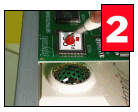
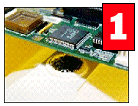
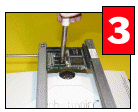
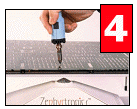
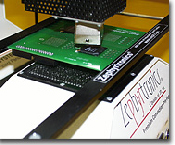
The Originals! No One Knows More About Preheating PCB's Than Zephyrtronics®!
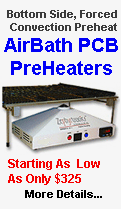
ZT-1 HIS PRE-HEATING AIRBATH™ SYSTEMSBottom-Side Convection PCB Pre-Heat for Thru-Hole, SMD, SMT, QFN & BGA Rework & Repair. Our Heavy Industrial Series!
Effective, Powerful 800 Watts With 25 CFM AIR SUPPLY (710 Liters per Minute)
Zephyrtronics' AirBath “bathes the circuit board in warm air to reduce thermal stresses
to the board and its components.”-- NASA Report, January 9, 2004
This is
the world-first, original
and, internationally acclaimed, award-winning and patent-protected
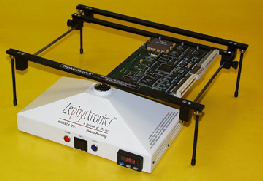
ZT-1-HIS
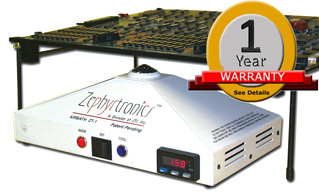
Heavy Industrial AirBath™
preheat system -- your
effective solution
for preheating PCB's for low-volume prototyping
or in rework.
Two Models! Our
ZT-1-HISAirBaths™
are available with either analog or digitalcontrol. Both
models have powerful 25 CFM (710 Liters/Minute) of air
supply.
Chosen By Boeing
for the
TM
International Space Station Project.
This is the AirBathTM
that Forever
Triggered
PCB Preheating at the Benchtop!
Greater volume of air supply preheat
with far lower
temps than with other ineffective preheat devices
limited by low air volume outputs, which require higher
temps and burn your boards. Not a preheating "toy", this is
real preheating!
And in our famous trademark pyramidal design!
800+ Watts of Power:
Coupled with ample air output is
our 800+ Watts of preheating capacity. This is effective
preheating by design!
ZT-1-HIS HEAVY INDUSTRIAL AIRBATH™ PREHEATERS
DESCRIPTION
MODEL
BUY NOW
TM
DIGITAL
AIRBATH
25 CFM
Air Power
(710 Liter/Min) 850 Watt Power
ZT-1-HIS-DPU-120
120 Volt for the U.S., Canada & Mexico
$1,495
ZT-1-HIS-DPU-230
230 Volt for
Our International
Customers
$1,495
TM
ANALOG
AIRBATH
25 CFM
Air Power
(710 Liter/Min)
800 Watt Power
ZT-1-HIS-MIL-120
120 Volt for the U.S., Canada & Mexico
$1,295
* The HIS Series is our mid-range capacity of preheaters in our extensive
 AirBath Preheater Product Line. Nothing beats a Zephyrtronics AirBath at
 repairing Smartphones, Tablets or Flat Screen televisions. Quality, twenty
 years on the market and a 1 year warranty (see details below).
Preheat Power:
Our
ZT-1-HIS AirBaths™
ample air supply
from the AirCone™ delivers its forced-convection preheat
power for even the most challenging PCB's.
Beware of imitative
pre-heaters with less than 13CFM (360 liters/minute) that
crudely attempt to compensate for wimpy air volume
through
higher temp settings.
Remember: the glass transition of a FR-4 PCB is only
170°C. You don't want higher preheat temps, you want
higher volume of safe preheat (100°C-170°C).
So
Many Features:
The AirBaths™with the Zephyrtronics ZeroTouch™
preheat get into a PCB's nooks and crannies where hot plates
and IR preheaters can't go (see videos below). Fabricated from steel, not plastic for industrial use and long production life,
they
are RoHS Compliant, ESD-safe, exceed U.S.
Military Specs and uniquely feature indicator lights
(blue: cooling;
red: preheating).
All AirBaths™ have
internal air supply so you do not need
compressed air hook ups......and
our ZT-1-HIS-DPU
Digital Model has our very big LED lighted digital
temperature display for quick "set & read" not tiny,
impossible-to-read, and simply horrible LCD's for displays!).
Thermal
Ramping: AllAirBaths™ have the
industry standard, temperature ramp of 2°-4°C per
second "built-in"
to prevent
thermal shock
to semiconductors, sensitive chips, ceramic caps and glass diodes.
Indeed, our integrated ramping was essential to Motorola®
and Boeing®
with their space applications. And they are essential for
high-quality smartphone, tablet, pc and flat screen
television soldering and desoldering repair.
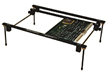
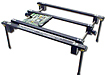
ABC SERIES OF ADJUSTABLE BOARD CRADLES™
DESCRIPTION
MODEL
BUY NOW
ADJUSTABLE BOARD CRADLE
3-RAIL (10” X 18” MAX)
ABC-1
$345
ADJUSTABLE BOARD CRADLE
3-RAIL (20” X 18” MAX)
ABC-2
$395
ADJUSTABLE BOARD CRADLE
QUATRO (10” X 18” MAX)
ABC-1-Q
$395
ADJUSTABLE BOARD CRADLE
QUATRO (20” X 18” MAX)
ABC-2-Q
$425
More Details
For
Thru-Hole, SMT & BGA Preheating Tasks: TheHIS Series AirBath Preheating Systems
is ideal for all PCB challenges from low-volume production
runs, prototyping during design or during rework with all
SMD packages such as
BGA, CSP, QFP, QFN,
TSOP, PLCC, SOIC, SOL, LCC, Flip Chip and Glob Top
components. Still, the AirBath
is not limited to only SMD devices: Don't overlook the
superb benefit the
AirBath preheating boost brings to your
tough through-hole (PTH) soldering and de-soldering tasks!
Plus, it easily handles all substrates including FR-4,
polyimide, composites, flex circuits and ceramic boards.
The Many
Benefits of Preheating Your PCB:
The
benefits of preheat
are multiple and compounding. 1.) Preheating or
"soaking" the assembly before reflow activates the flux that
removes oxides and surface films thereby enhancing the
wetting process and solder joint quality. 2.) Preheat
permits lower soldering reflow temperatures. 3.) Preheat
reduces "dwell time" at the final reflow stage. 4.) Preheat
reduces thermal stresses to the PC substrate and components
if localized reflow is made with soldering irons,
de-soldering tools or hot air tools. 5.) Preheat gives a
thermal boost for RoHS lead-free solders without
damaging the work!
The HIS Series of AirBaths™
is
available in two models: Analog and Digital. Both models
feature variable temp selection from ambient up to 205°C and feature
closed-loop feedback temperature sensing control. The digital model
incorporates a digital set/read lighted display that permits single
digit/degree incremental temperature selection in the "set" mode and
tracks real time temperature at the air exit point above the grids.
Our Analog Model provides the two most common preheat settings:
100°C and 150°C.
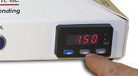
Model ZT-1-HIS-DPU
With
Digital Temp Control & Big LED
Lighted Display
(Not Impossible to Read LCD's!) With Temp Set & Read
Functions
on Front Panel.
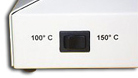
Model ZT-1-HIS-MIL
With the 2 Most Common
Preheat Temps:
100°C &
150°C
By Rocker Switch on
Back Panel.
Your Lead-Free Solution: Working with
lead-free, RoHS solder alloys --- all have higher
melting points --- makes preheat essential to PCB
work at a bench. Don't raise temps higher on your
soldering irons, desoldering tools, hot air tools or thermal
tweezers! A brief preheat
below the PCB permits soldering/ desoldering at lower temps.
The
RoHS Lead-Free Solder Mandate:
Europe (and Japan) no longer permit the
use of traditional tin/lead solders.
Learn more about the
European Lead-Free
Mandate & Preheating.
AirBath™ preheaters are your RoHS
solution making lead-free soldering a breeze.
All Pre-heaters Are Not Created Equal
1. Achieve Superb Thermal Profiles at the Bench with
industry standard 2°-4°C ramping to preheat!
This critical ramp is
"built in" to all AirBaths™ preventing thermal shock to
ceramic capacitors, glass diodes and temp
sensitive chips. Ramping helps prevent "pop-corning" of
moisture within I.C.'s. Preheat allows flux
activation and lower temps on the topside of the PCB
with your soldering tools. Effective preheat prevents
scorched substrates, damaged pads and chips in rework
or prototyping.
2. DeSolder &
Remove SMD's under 150°C (300°F)
with only
AirBath™preheat
and
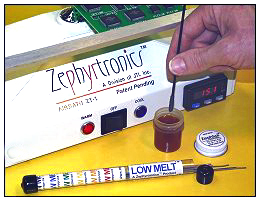
LowMelt®DeSolder
by the co-metalization process. No nozzles! No
lifted pads! No burned PCB's!
Video: SMD Removal With LowMelt®.
4.
Thru-Hole Rework:
Heavy ground planes? High copper content? Big heat sinks? No
problem! Your
AirBath™ makes de-soldering thru-hole chips a
breeze! Place your PCB over the AirBath™,
lower the temps on your desoldering tools. Stop lifting
pads.
You'll never
de-solder thru-hole without preheat again.
5. Ideal for Shrink Tubing,
the AirBath™
is temperature controlled unlike heat guns that burn and
tear insulation and shrink tubing.
6.
BGA, QFN Soldering & DeSoldering.
The
AirBath™ is a stand-alone, yet also a modular
part of the
ZT-7BGA Hot
Air System.
The AirBath™ has
the essential features for BGA processing:
industry standard ramp rate; "post-cooling" rapid
cool-down (required for BGA's; and 25CFM (710
Liters/Minute) of
preheat power permitting lower final reflow temps.
Video:
BGA & SMD De-Soldering in 3 Minutes.
Preheating PCB at Benchtop
Mimics High Quality Thermal Profiles on Production Floor
Remove Chip Quickly at Less
Than 150°C with AirBath &
LOWMELT®
"Never Lift A Pad"
100% Non Contact , SMT Hot
Air Solder Reflow With the AirBath and a
Hot AirPencil.
Yields Highest Quality Joints.
Easy Thru-Hole Desoldering
At Lower Temps With AirBath Preheat Heavy Ground
Planes? No Problem!
AllAirBaths™
Sit
Below
the
ZT-7-MIL
BGA, SMD & Thru-Hole Hot Air Station.
Ideal
For Heat Shrink Tubing Applications.
Far Superior To Uncontrolled Heat Guns!
Comparing the Four Methods of Preheating
Preheating PCB assemblies falls into four categories:
1.) hot plates, 2.) ovens, 3.) IR systems, and 4.)
forced convection (warm air) under a PCB:
The short video at the right breaks down these four
methods with comparative demonstrations.
While any PCB preheat prior to soldering is
better than none, an objective analysis of the various
methods of preheating reveals that
all preheating methods are not equally effective or
beneficial:
1.) Ovens:Using ovens to preheat before rework
and soldering for either removal and/or
replacement of components can yield the most uniform
temperature profile as it warms both the top and bottom
of the PCB as ovens also do in high volume production
equipment such as conveyor ovens and wave solder
machines. It's just a little problematic to crawl inside
an oven with your PCB to preheat while you perform
selective soldering or desoldering tasks on one side of
the board. Of course, one can preheat with an oven, and
then rush the PCB back to your bench, but it's hardly
practical or convenient solution.
Hundreds of Zephyrtronics AirBaths™
Utilized to
Build the International Space Station (ISS)
39-Page
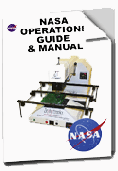
Rework Guide
by NASA with Zephyrtronics AirBaths™
Zephyrtronics AirBaths™ Used on the Mars Rover &
Phoenix Programs.
Photo Credit: NASA
3.)
Hot Plates:
The obvious
limitation to the hot plate is that not all PCB
assemblies are single sided. In today's world of
hybrid and mixed technologies, the PCB that is
entirely flat or plane on one side is an exotic
and rare creature indeed. PC board
assemblies are never the same from one to
another. They can be populated with many
disparate devices such as heat-sinks,
connectors, relays, and transformers on both sides. These uneven surfaces on PCB'
present an indirect path of heat conduction from
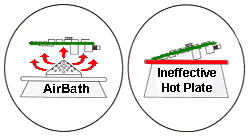
hot plates to the board.
"Hot
air is more versatile than a hot plate due to
non-uniform parts on the bottom of the PC Board." Glen Dody, Motorola Lab National Journal of SMT, '96
4.) Superior AirBath™
Forced Convection Preheat™The PC board assembly market
has long spoken with regards to the
distinct advantages and superiority of a
warm air
bath in the pre-heating
process. It is why most all high
reliability governmental and quality
commercial PCB production, design and
rework/repair groups stick to and with
forced convection preheating: it is
superior.
Forced convection completely disregards
the topography (or bottomography) of a
PCB, allowing immediate, direct access
of the warm air into all of the nooks
and crannies of the PCB assembly. And
much like the newer, popular forced
convection commercial ovens, the
circulating warmed air is far more
effective than static warm air.
Unlike IR "systems", there's another
tremendous advantage with Zephyrtronics
AirBaths™ -- temp control is "built-in".
No small distinction! No fumbling with
taping
thermocouples on top of PCB's. AirBath™
preheat has temp control
by dial or push button with accuracy and
repeatability saving time, hassle, scrap and
money.
Finally, forced convection preheaters
can also multi-task for cooling down PCB's
after soldering which is critical to
solder joint integrity as the
next section explains.
2.)
IR: There are
many drawbacks with infrared and why it really never completely caught on. Some of
those drawbacks (enumerated in articles and white
papers) are the difficulty in ramping temps,
darker surfaces heating more than lighter ones
('albedo' effect), shadowing caused by high
profile devices on PCB's. IR preheaters can warp
PCB's and some chips require
IR shielding with aluminum foil! If an IR preheater is very large,
working on small PCB's can be very uncomfortable for techs (a common complaint).
Another quality disadvantage
of IR preheaters is they are not
"temperature controlled"
without taping an
external thermocouple onto each PCB before
working on it...a hassle/headache for techs and filled with quality pitfalls,
and inconsistent results. There are more
drawbacks, but these are some of the worst.
NASA & JPL: 'IR Preheaters Are Risky':
Addressing the preheating
process for heat sensitive chips in a
49-page published report, two JPL engineers, Dr.
Rajenshuni Ramesham and Dr. R. David Gerke,
wrote "Hot
plates and infrared preheaters are not
recommended for this type of rework. The
reason that they should not be used is that the
thermal reaction times, energy transfer rates
and efficiency are never consistent. However,
they can be used for large metal and
ground-plane boards in limited applications,
e.g., where the size of the board matches that
of the preheater in area."
Citing the late
William Scheu, the authors point to the
superiority of bottom-side preheating with forced
convection systems. The JPL/NASA Survey
spotlighted still more of the deficiencies of IR
preheating devices: "They have little
capacity to ramp and soak to perform properly
engineered repair scenarios or to support the
creation and application of complicated thermal
profiles. They also are limited in their ability
to preheat beyond the physical dimensions of the
heating surface. Hot-air preheating can be
ramped, soaked and, on some systems,
synchronized with the reflow process, permitting
duplication of the actual profile used in
manufacturing the assemblies. BGAs and
photoelectrical parts are sensitive to higher
temperatures and
any
attempt to preheat with marginally controllable
sources is risky."-- NASA & JPL: Survey
of Rework Methods & Equipment for Various
Packaging Technologies"
Aug.'05
Post-Cooling™ Feature Built Into The AirBaths™
Post-Cooling™ Mode Cools Down BGA's After Reflow
Within 8 Seconds Allowing Quicker Lifting Hot
Air Nozzles Preventing Bridges
Another AirBath™ Advantage: flipping
a
switch transforms the unit into a post-cooler™
cooling down your PCB, chips and solder joints.
PostCooling™ is essential to soldering BGA's
because hot air nozzles must never be lifted from
above a BGA until all the balled joints have
cooled to prevent unwanted bridging.
Important: hot plates, static ovens and IR
plates do not provide the critical post-cooling™
feature standard on every Zephyrtronics
AirBath™.
Zephyrtronics
Introduced PostCooling™ PCB assemblies to
the benchtop clear back in 1994. Our
AirBaths™ cool BGA's enough within 8 seconds so
a hot air nozzle can be lifted without fear of
bridging.
Without post-cooling™ techs must wait
for the ball/pad interface to solidify
completely before lifting a nozzle to inspect.
Post-Cooling™ remedies this problem for rapid
lifting nozzles off BGA's after soldering.
The AirBaths™
Established
the Standard for PCB Preheating.
Our
AirBaths™
inspired a lot of cheesy imitations, but we're still the
pioneers who understand thermodynamics and preheat better
than anyone else. Our
AirBaths™
are the intelligent solution to stop burning up your PCB's by preventing thermal degradation,
thermal shock, lifted pads or traces, substrate
delamination, measling and warping.
Twenty Years!
Zephyrtronics
AirBaths™
are still the first choice for PCB preheating by most major
aerospace and semiconductor manufacturers after two decades. It truly is the one
single tool that belongs on every bench. This is the
"Science of Zephyrtronics." We have an
AirBath™
for you.
TECHNICAL DATA & SPECS
Models: ZT-1-HIS-DPU-120120 VAC (US, Canada & Mexico)Digital Model ZT-1-HIS-DPU-230230 VAC International Digital Model
ZT-1-HIS-MIL-120120 VAC (U.S., Canada & Mexico)Analog Model
Other: (All Models)
Power:800 Watts
Electrical Construction: 3-Wire Input with Earth Safety Ground W x H x D:12" x 4.5" x 7.2" (30 cm x 11 cm x 18 cm)
Weight:5.3 lbs (2.41 Kg)
Air Volume: 25CFM or 710 Liters/Minute
Temperature Modes: Preheating & Cooling from AirCone™
Preheat Temp Range: Ambient (Room Temp) to 205°C (400°F)Preheat Ramp Rate: 2-4° C per second
Cooling Temp: Ambient (Room Temp) Temperature Stability:± 3°C (± 5 °F) at Idle.Absolute Temperature Stability:Meets or Exceeds ANSI-J-STD Air Supply: Self-Contained Internal Supply (No Air Hookups)
Construction: All Metal ESD Safe Construction
Warranty: One Year Limited Warranty Parts & Labor
Recommended: Use With ABC Series of Board Cradles / Fixtures
FEATURES & BENEFITS
The Preheating System Used By Boeing on Int'l Space Station
Prevents Thermal Shock of Components
Permits Lower Soldering & DeSoldering Reflow Temperatures
Ideal for the Heaviest PCB's & Lead-Free Applications
Helps Prevent Warping Substrates & Damaging Pads
Superior Forced Convection Preheating
800  Watts of Preheat Power
Powerful 25 CFM (710 Liters/Minute) Air Volume
Digital & Analog Models
Big Indicator Lights.  Red:  Preheat.   Blue: Cooling
Analog Preheating Model:  Dual Settings 100°C & 150°C
Digital Preheating Model: Variable from Room Temp to 205°C
Preheating Ramp Rate at Industry Standard 2°-4°C Per Second
Self-Contained (No Air Hook-Ups Required)
Small, Compact Construction Saves Benchtop Space
ESD Safe
One Year Limited Warranty Parts & Labor
Every Unit is Calibrated at Zephyrtronics' California Factory
ZT-1-HIS HEAVY INDUSTRIAL AIRBATH™ PREHEATERS
Description
Model
Price
Buy Now
TM
DIGITAL
AIRBATH PREHEATING SYSTEM
25 CFM Air Power 850 Watt Power
ZT-1-HIS-DPU-120
120 Volt
for the U.S., Canada & Mexico
$1,495
ZT-1-HIS-DPU-230
230 Volt
For All
Int'l Customers
$1,495
TM
ANALOG
AIRBATH PREHEATING SYSTEM
25 CFM Air Power 800 Watt Power
ZT-1-HIS-MIL-120
120 Volt
for the U.S., Canada & Mexico
$1,295
* We manufacture many other sizes of AirBaths.  Note that the HIS Series is our mid-range capacity of pre-heaters
within our extensive AirBath Catalog.  We have an AirBath Preheater tailored to your company's PCB needs.
ABC SERIES OF ADJUSTABLE BOARD CRADLES™
Description
Model
Price
Buy Now
ADJUSTABLE BOARD CRADLE
3-RAIL (10” X 18” MAX)
ABC-1
$345
ADJUSTABLE BOARD CRADLE
3-RAIL (20” X 18” MAX)
ABC-2
$395
ADJUSTABLE
BOARD CRADLE
QUATRO (10” X 18” MAX)
ABC-1-Q
$395
ADJUSTABLE BOARD CRADLE
QUATRO (20” X 18” MAX)
ABC-2-Q
$425
OPTIONAL ACCESSORIES
Description
Model
Price
Buy Now
EXTRA / REPLACEMENT
POSTS
(SET
OF
4)
2-Post
and
8-Post
Positioning
(8
Posts
Allow
PCB
&
ABC
to
Be
Flipped
Up &
Down
For
Thru-Hole
De-Soldering
&
Inspection)

















 T
T